Friday, March 16, 2012

Kepler's First Law

Johannes Kepler was a very famous astronomer. He was one of the first astronomers to understand the physics behind our solar system and how objects orbit one another. If you ever take a course in astronomy, one of the first concepts you will learn about is Kepler's three laws of planetary motion. Today I introduce Kepler's first law of planetary motion.


Kepler's first law: Planets orbit the sun in an ellipse with the sun at one foci .

With the technology and telescopes that we have today, it's easy to show that planets follow a squished circular shaped path around the sun called an ellipse . But how did Kepler know? Back in the early 1600's, astronomer and physicist Tycho Brahe took very precise measurements of the position of Mars in the sky. At the time, astronomers believed that all planets orbited in a circular path with the sun at the center. Assuming this is true, Brahe calculated where he expected Mars to be located in the sky throughout the year. To his surprise, the position of Mars never matched his prediction! He then gave Kepler the task of figuring out why the data and predictions did not match. Kepler discovered that if you model the Earth and Martian orbit using ellipses with the sun at one foci, Brahe's predictions would match up perfectly with his observations! We can quantify how "squished" the circle is using a parameter called eccentricity. An eccentricity of 0 means the planets path is a perfect circle. An eccentricity of 1 means that the planets path is a straight line. Planets orbit with eccentricities between 0 and 1, and most of the planets in our solar system have an eccentricity of <0.1 i.e. almost circular. This law is universal, which means it can be applied to extrasolar planetary systems as well as our own.

Monday, March 12, 2012

Van Allen Belt


Earth is surrounded by a large magnetic field caused by a molten iron core deep inside the planet. It's very similar to the bipolar magnetic field produced by a bar magnet, just on a much larger scale. The field lines extend out one pole, wrap around the earth, and re-enter at the other pole, creating a magnetic barrier around Earth. The Van Allen Belt is the part of this barrier, where most of the high energy particles aimed towards Earth are collected and safely grounded at Earth's poles. It sits about 20,000km above Earth's surface, well within the orbit of the moon. There are actually two Van Allen belts, an inner and outer one, which trap different types of particles.

This is a great thing for humans on Earth, but it poses big problems for satellites, telescopes, and space travel. Telescopes and satellites that travel through the Van Allen belt can be easily damaged by this highly concentrated radiation. This is why most satellites orbit within the belt, and most space telescopes have orbits that do not cross the belt, or cross through it once to get to a further destination.  The Van Allen belt is also a big problem for astronauts. Without special equipment, humans can not safely pass through the belt, as they would instantly be poised by the radiation. Special protective equipment from astronauts and the space shuttle was developed so that astronauts on the Apollo missions could travel safely to the moon and back.

Friday, March 9, 2012

Space Weather

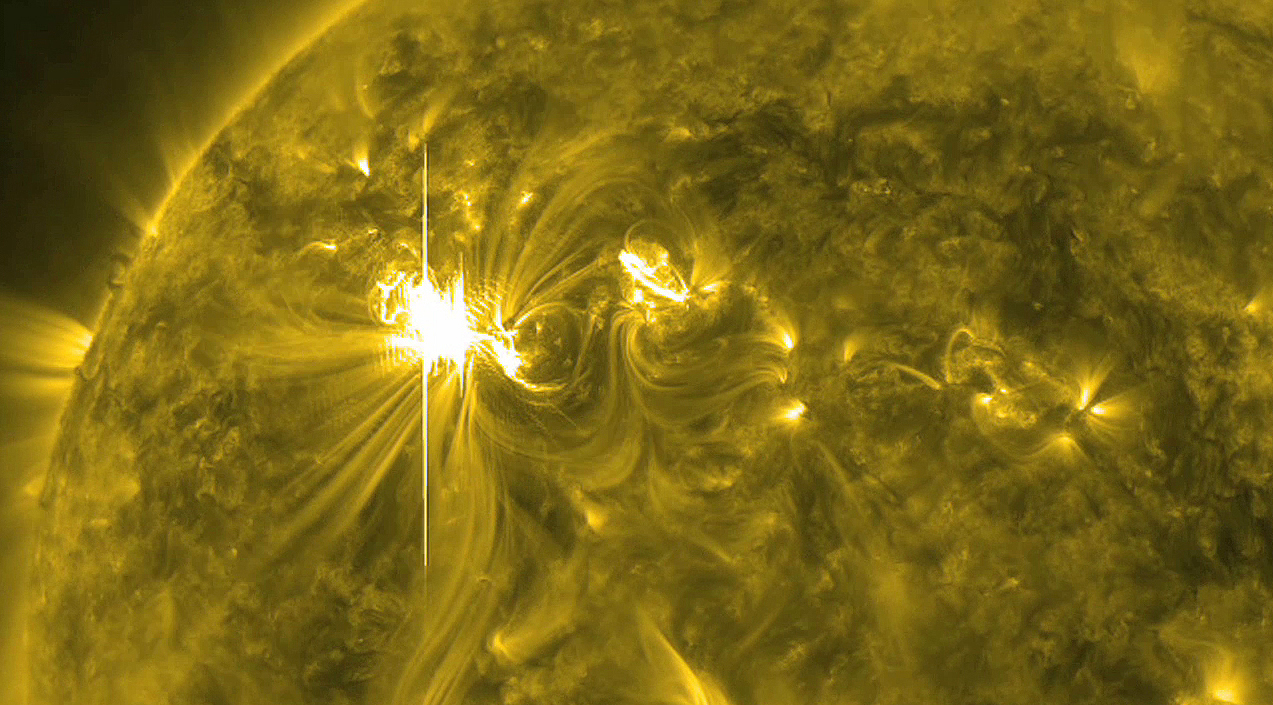
CME March 7th, 2012

The sun has been very active lately! It's reaching the peak of its 11 year sunspot cycle, and therefore solar storms and flares are more prominent. You probably heard about the giant solar flare that smacked into Earth early yesterday from your favorite news channel, but there are many places on the web where you can get information that's a bit more detailed than what your news anchor says. One of my favorite places to visit is SpaceWeather.com. Here you can find all sorts of information about the sun, solar storms, solar flares and other space weather related things. It also shows you a daily picture of the sun in case you are looking to view sunspots. There's information about the speed of the solar wind and any types of flares that are headed our way. Today, the solar wind is hitting us at 296 km/s (that's 662,000 miles per hour!) You can also check the site to see when objects such as the international space station will be visible in the night sky.
 

Tuesday, March 6, 2012

Measuring Temperature with Light

If you have ever read a news article or scientific paper on a star or group of stars, the author may have given a temperature for that star. But how do they know how hot the star is? There are many methods that astronomers use to estimate the temperature or all sorts of objects, but the simplest way is just to look at light! 

  
Astronomers assume that objects such as stars, planets, etc. in space emit like blackbodies. A blackbody is an object that emits a majority of light over one small wavelength range that directly corresponds to its temperature. Let's take the sun as an example. The image above is a blackbody curve for our sun, where the vertical axis is amount of light emitted and the horizontal is the wavelength or color of light. This graph says that the sun emits most of its light around ~0.5um (yellow) and not much at other colors. Emitting mostly at yellow means you have a temperature of ~5800 Kelvin. If you emit most of your light at shorter wavelengths, then you are hotter. If you emit more light at longer wavelengths then you are colder. Graphs like this can be made for any object just by observing it through different filters with a telescope. This method works best for objects that emit light in the UV, optical, and Infrared, and with one simple equation astronomers can calculate the temperature of an object based solely on its color. We can't always use this method measure the temperature of objects that emit in the x-ray or radio, because this light is usually not caused by heat, but by other mechanisms.

Humans emit most of their light in the infrared, which is why we glow fun colors in pictures taken with infrared cameras. Based on this fact, we can figure out that humans have a temperature of ~310 kelvin, or 98F. So this method works both on Earth and in space!

Image Credit: Quantumfreak.com

Saturday, March 3, 2012

The Sun Today and Every Day


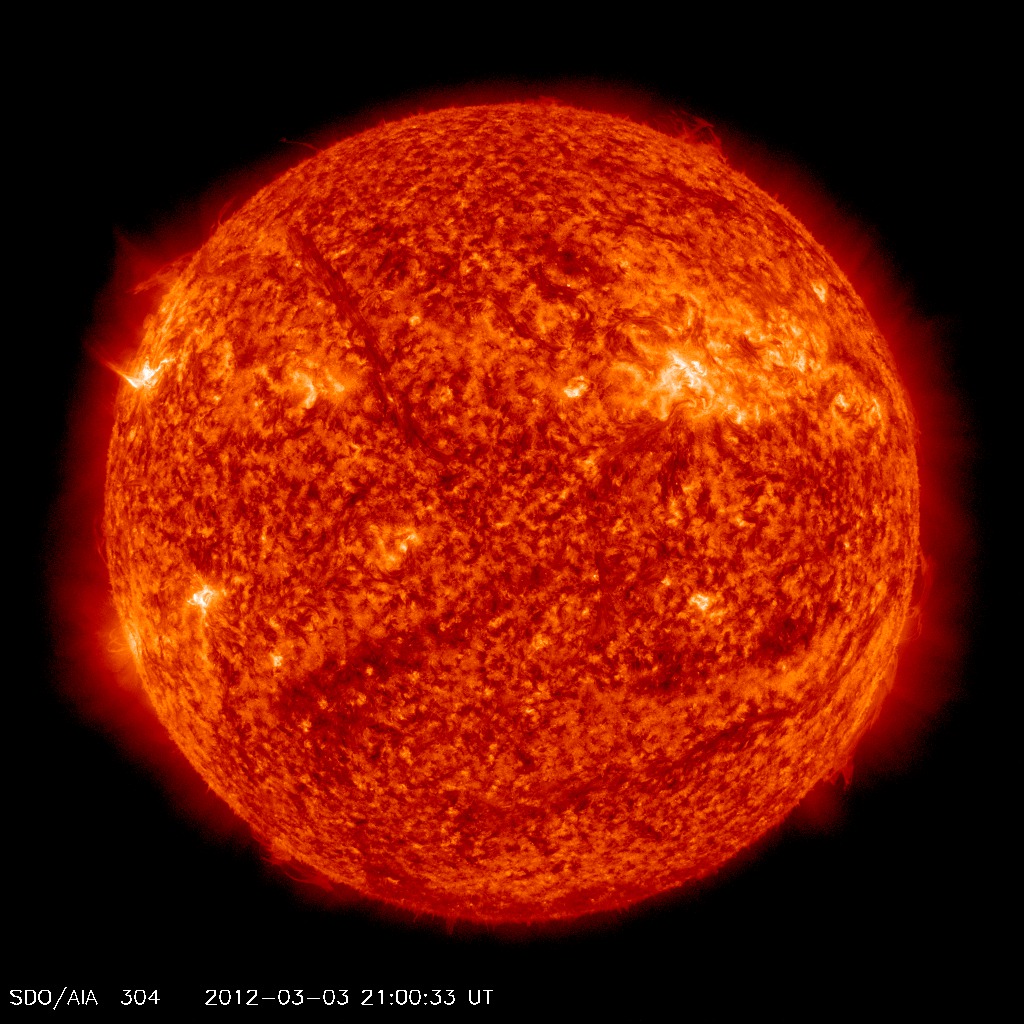
The Solar Dynamics Observatory (SDO) launch in early 2010 and has been studying the sun ever since. SDO focuses on understanding solar storms and the sun's magnetic field, and how all this affects us here on Earth. You can check the SDO website and see what the sun looks like every day! Today we can see a few sun spots and prominences. What will the sun look like tomorrow? We'll have to wait and see!

Image Credit: SDO

Wednesday, February 29, 2012

Happy Leap Day!

 Today, February 29th 2012, is leap day! Every four years an extra day is added to the calendar in February to make up for the fact that one full year is actually ~365.25 days.  But why is it defined this way and what does astronomy have to do with it?

Throughout history, many changes to our calendar have been made so that the seasons and solstices occur on roughly the same dates every year. Since the 16th century we have been using the Gregorian calendar system, which defines one year to be 365days, and one leap year to be 366 days. Every four years we have a leap year, except for years which are divisible by 100 and not divisible by 400. So, for example, the year 2000 was a leap year (divisible  by 100 and 400) but the year 2100 will not be a leap year, because it's not evenly divisible by 400. If you do the math, this results in the average number of days in a Gregorian year to be 365.2425 days. This coincides with amount of time it takes the Earth to go around the sun once (~365.2425 days). This makes sense, but Earth's orbit does not stay in the exact same place in space year after year. This slight shift in Earth's orbit is called precession. This results in a tropical year (the time it takes to go from the exact time of the winter solstice one year to the next) to occur on a 365.24219 day schedule.  So in general thing line up nicely, but actually, we are overestimating  by a tiny amount. If we want the seasons to line up correctly, we will have to make an additional one day correction every ~26,0000 years.  This also doesn't include other astronomical changes to the Earth that occur on even longer timescales, but during your lifetime you shouldn't notice any change between seasons and the dates they occur on.

Monday, February 27, 2012

Core Collapse Supernova


Crab Nebula Supernova SN1054 remnant

When stars much bigger than our sun reach the end of their life, they often experience huge explosions called supernova. They leave behind beautiful supernova remnants like the ever popular crab nebula (pictured above). But why do these stars die in such violent ways? The answer lies deep inside the star.

Stars spend most of their life fusing Hydrogen in their core, which is what makes them shine so brightly. After a star uses up a good amount of its hydrogen, it can start burning heavier elements such as helium, oxygen, carbon, and silicon. It continually burns heavier elements, creating onion like shells of elements on the core, until it gets to iron. At this point, the core is so hot that the light it releases is able to break apart elements down to its constituent protons, neutrons and electrons, essentially undoing the creation of heavy elements that the star just spent its whole life doing. The pressure in the core that's holding up the now "puffy" star begins to decrease and eventually the star implodes on itself. The in fall of material eventually bounces off the now super dense core, creating a shock wave outward. If the shock wave has enough energy, it will burst through the surface of the star, as what we call a core collapse supernova explosion! It essentially blows the star apart, leaving behind only the super dense core, now called a neutron star.

Image Credit: NASA/HST