You've probably seen a full moon many times during your life, but have you ever noticed that it always looks exactly the same? The Earth and the moon are tidally locked to each other, which means that the same side of the moon always face Earth. This can happen when you have a small body close to a large body, and gravitational interactions cause the small objects orbit and rotation to synchronize. Let me explain. Intuition tells most people that if you always see the same side of the moon, then the moon must not be rotating on it's axis. But this is not true! You can convince yourself of this by doing a little demo with your hands. Hold up your right hand and make a fist, then point the fingers of your left hand toward it. Now move your left hand around your right, such that the tips of your fingers always point to your right fist. You'll quickly find that you have to rotate your left hand to do that! The moon goes around the Earth once every ~28 days, and it rotates on its axis once every ~28 days as well. This causes the same side of the moon to always face Earth! Planets that are close to their host stars can be tidally locked in the same fashion, and so can two stars. Many moons in our solar system are known to be tidally locked to their host planet, and astronomers speculate that many known exoplanets are tidally locked to their host stars.
Thursday, February 2, 2012
Monday, January 30, 2012
RR Lyrae Stars

Globular Cluster M15 which contains RR Lyrae stars
When we hear the word star, we think of a big flaming ball of gas like our sun. Our sun is a "typical" star, but there are many other types of stars in our galaxy. An example of a different type of star is an RR Lyrae star. These stars belong to a class of different types of variable star, or stars that change their brightness periodically over time. RR Lyrae stars are found in globular clusters, and are more aged and contain less heavy metals than the sun. Reactions in the star's core cause the star to physically pulsate periodically in size, temperature and brightness. They change brightness on the order of days. RR Lyrae stars are being studied by many astronomers so that we can understand and accurately predict the brightness changes of these objects.
Image Credit: Efrain Morales Rivera


Friday, January 27, 2012
A Supercritical Exoplanet

One of the main goals in searching for exoplanets is to find one similar to Earth. Astronomers are beginning to find planets that are roughly the same size and weight as Earth, but are quickly discovering that these planets have few other similarities to Earth. 55 Cancri e is an excellent example. This exoplanet is roughly 8 times the weight of Earth, and a little less than twice the size. The image above shows Earth and the exoplanet to scale, though the drawing of 55 Cancri e is just an artists idea, we have no idea what it really looks like. The two planets are comparable enough to call 55 Cancri e a "Super-Earth". One major difference between Earth and 55 Cancri e is that it sits much closer to its host star than Earth does to our Sun. For comparison, 55 Cancri e is 26 times closer than Mercury is to the sun, and Mercury is 3 times closer to the Sun than Earth! Observations with the Spitzer Space telescope suggest that the planet is not rocky, but actually made of lighter elements, including water! Since the exoplanet is so close to its host star, it is extremely hot. This means that any elements are in a "supercritical" state, or in other words they are in a liquefied gaseous state. Here on Earth we have super critical water near heat vents, and liquid rocket fuel is super critical when ignited. Essentially, this planet is oozing with super hot material! Definitely not a place I'd want to live!
Image Credit: NASA
Wednesday, January 25, 2012
Ebb and Flow

GRAIL A and B are lunar satellites launch by NASA that will be studying the gravitational field of the Moon (see GRAIL). The spacecrafts just arrived at the moon on December 31st 2011 and January 1st 2012. To get the general public involved in the mission, NASA decided to hold a competition for elementary school students in which they proposed new, more creative names for GRAIL A and B. The winners are a class of fourth grade students from Montana, who came up with the names "Ebb" and "Flow". Ebb means to move back or away (like a receding tide), where as flow means to move forward, like a flowing stream. The Moon's gravity is what causes the tides to occur, and since GRAILS primary mission is to study the Moon's gravity and how it affects Earth, these names are quite appropriate. Keep an eye out for other space related competitions that you can participate in on the NASA website: www. NASA.gov
Image Credit: NASA
Friday, January 20, 2012
Dragonfish Star Cluster
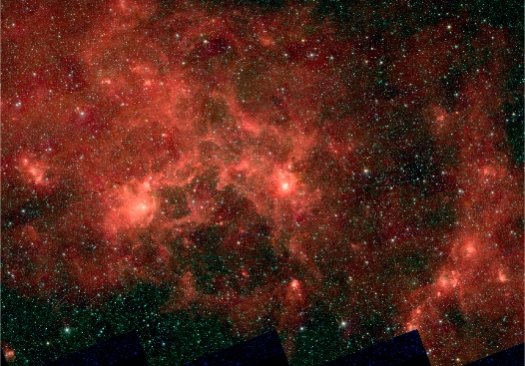
The Dragonfish star cluster is a group of very massive stars that are embedded in a thin bubble of gas from which they formed. This cluster was recently discovered using the Spitzer Space Telescope, and further studied using the New Technology Telescope in Chile. It's name comes from the fact that the shell of gas (bottom middle) resembles the snarling mouth of a dragonfish. This cluster is made up of many massive stars, some of which may even be 100x the size of our sun! The region around the fishes eye (bright star in the middle) contains more gas and could still be forming stars. Stars this massive don't live very long, so it's likely that star formation in this region won't last very long, as a supernova explosion could blow away most of the material in the next few million years!
Image Credit: NASA/JPL-Caltech/GLIMPSE Team/Mubdi Rahman
Wednesday, January 18, 2012
Voyager Golden Records

Voyager Golden Record (left) and the case it's contained in (right)
In 1977, NASA launched a pair of telescopes called the Voyager Space Telescopes. They were designed to travel to the edges of our solar system and beyond, and send back as much information as possible along the way. Since astronomers knew that these telescopes would be leaving the solar system, they wanted to have something on board signifying the telescopes origins, just in case they were picked up by an alien species some day! So onboard these telescopes are two gold plated records called the Voyager Golden Records. The records contain greetings from Earth in many languages, images of various places, and different iconic sounds. Directions on how to build and use a record player are etched on the case that holds to records. The star like symbol shows some of the nearest and brightest stars to Earth. This was placed there to help any alien species pinpoint Earth's location in space. The Voyager Spacecrafts are just now leaving the solar system and have a long way to go before they reach another planetary system. If you'd like to see some of their content, check out this website: http://spaceplace.nasa.gov/voyager-to-stars/
Monday, January 16, 2012
Itty Bitty Planetary System
Astronomers are working very hard to confirm the existence of potential exoplanets identified by the Kepler space telescope. One such confirmation was made recently, and it's the "smallest" one yet!

KOI-961 is a red dwarf star. This means that it still has fusion in its core, but it's much smaller than the sun. In fact, it's only 13% the mass of the sun, and is slightly larger than Jupiter in size! The image above shows KOI-961 and its three planets (to scale) next to Jupiter and four of its moons for a comparison of size. KOI-961 was not originally identified by Kepler as having an exoplanetary system. Astronomers from CalTech looked at the public data released by Kepler, and saw something suspicious in the light curve. They observed this star using both the Palomar Observatory and Keck Observatory, and their results confirmed the existence of a 3 planet system! The planets masses are unknown, but their sizes are ~0.57, 0.73 and 0.78 Earth radii. This suggests that they are rocky planets similar in size to Mars. Planets 1 and 2 are too close to the star to harvest life, but planet 3 is just on the inner edge of the habitable zone! Much more work is needed before we can truly speculate the existence of life on this planet, but the more discoveries we make, the better chance we have of finding a planet just like Earth!
Image Credit: CalTech
Subscribe to:
Posts (Atom)