Saturday, March 3, 2012

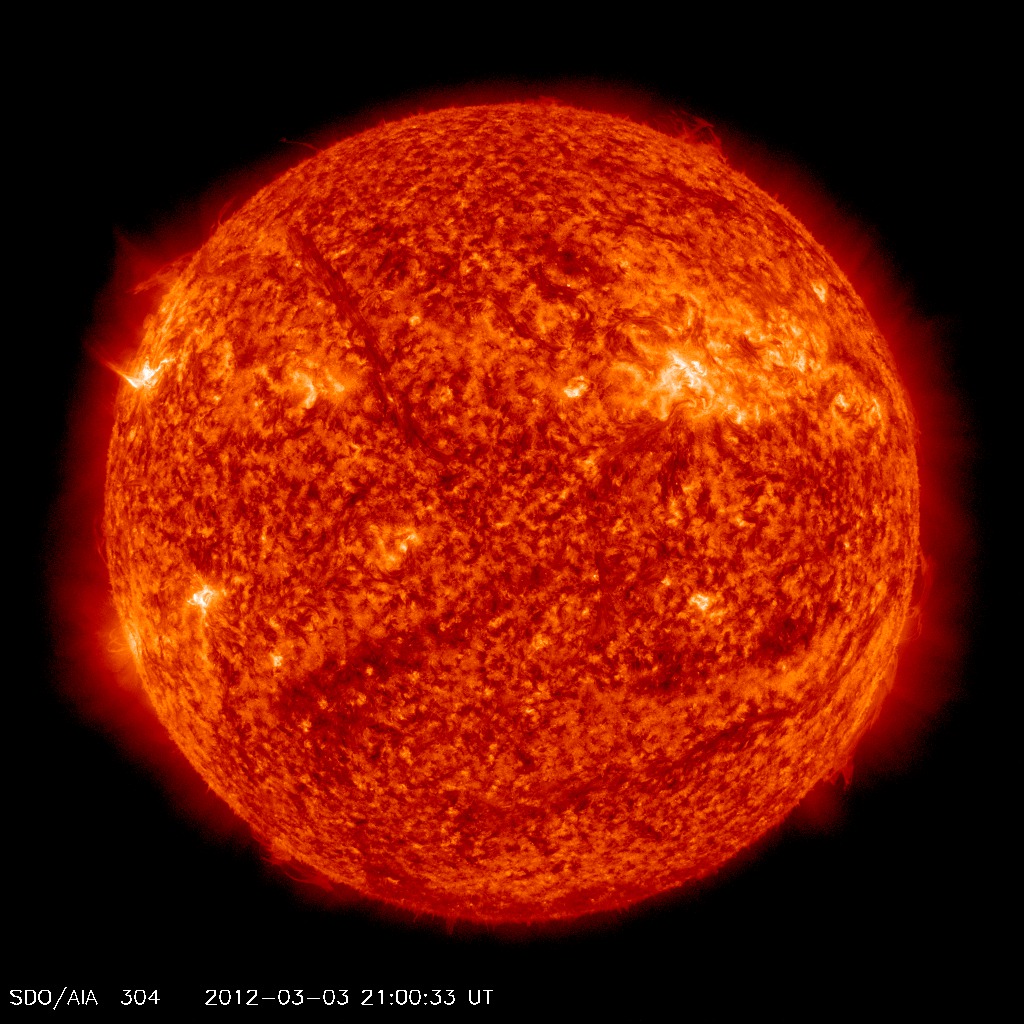
The Sun Today and Every Day


The Solar Dynamics Observatory (SDO) launch in early 2010 and has been studying the sun ever since. SDO focuses on understanding solar storms and the sun's magnetic field, and how all this affects us here on Earth. You can check the SDO website and see what the sun looks like every day! Today we can see a few sun spots and prominences. What will the sun look like tomorrow? We'll have to wait and see!

Image Credit: SDO

Wednesday, February 29, 2012

Happy Leap Day!

 Today, February 29th 2012, is leap day! Every four years an extra day is added to the calendar in February to make up for the fact that one full year is actually ~365.25 days.  But why is it defined this way and what does astronomy have to do with it?

Throughout history, many changes to our calendar have been made so that the seasons and solstices occur on roughly the same dates every year. Since the 16th century we have been using the Gregorian calendar system, which defines one year to be 365days, and one leap year to be 366 days. Every four years we have a leap year, except for years which are divisible by 100 and not divisible by 400. So, for example, the year 2000 was a leap year (divisible  by 100 and 400) but the year 2100 will not be a leap year, because it's not evenly divisible by 400. If you do the math, this results in the average number of days in a Gregorian year to be 365.2425 days. This coincides with amount of time it takes the Earth to go around the sun once (~365.2425 days). This makes sense, but Earth's orbit does not stay in the exact same place in space year after year. This slight shift in Earth's orbit is called precession. This results in a tropical year (the time it takes to go from the exact time of the winter solstice one year to the next) to occur on a 365.24219 day schedule.  So in general thing line up nicely, but actually, we are overestimating  by a tiny amount. If we want the seasons to line up correctly, we will have to make an additional one day correction every ~26,0000 years.  This also doesn't include other astronomical changes to the Earth that occur on even longer timescales, but during your lifetime you shouldn't notice any change between seasons and the dates they occur on.

Monday, February 27, 2012

Core Collapse Supernova


Crab Nebula Supernova SN1054 remnant

When stars much bigger than our sun reach the end of their life, they often experience huge explosions called supernova. They leave behind beautiful supernova remnants like the ever popular crab nebula (pictured above). But why do these stars die in such violent ways? The answer lies deep inside the star.

Stars spend most of their life fusing Hydrogen in their core, which is what makes them shine so brightly. After a star uses up a good amount of its hydrogen, it can start burning heavier elements such as helium, oxygen, carbon, and silicon. It continually burns heavier elements, creating onion like shells of elements on the core, until it gets to iron. At this point, the core is so hot that the light it releases is able to break apart elements down to its constituent protons, neutrons and electrons, essentially undoing the creation of heavy elements that the star just spent its whole life doing. The pressure in the core that's holding up the now "puffy" star begins to decrease and eventually the star implodes on itself. The in fall of material eventually bounces off the now super dense core, creating a shock wave outward. If the shock wave has enough energy, it will burst through the surface of the star, as what we call a core collapse supernova explosion! It essentially blows the star apart, leaving behind only the super dense core, now called a neutron star.

Image Credit: NASA/HST
Monday, February 20, 2012

Beating Extinction


Last ADYK we discussed extinction due to clouds of dust and gas in outer space. When we view objects like the pillars of creation in visible light, the stars are blocked by the pillars of clouds.  To beat the extinction, astronomers look at the infrared light coming from that region, which is able to pierce through the clouds revealing the hidden stars! Infrared light has a longer wavelength, so it's able to travel further and through more material before it gets absorbed or scattered. This is because most of the gas and dust particles are smaller that the wavelength of infrared light.  The concept is similar to that of radio waves. We use radio waves on Earth to transmit information because the wavelengths are very long, on the order of meters. So for the radio waves, things like people, buildings and trees appear "small" or on about the same size scale as the waves are. Therefore, the waves can travel pretty far before they are disrupted. Shorter waves, like millimeter long waves, wouldn’t travel very far on Earth because they are smaller than the objects they must travel past.  Going back to our pillars of creation, infrared waves emitted by the stars are longer than the size of the gas and dust, thus the light can travel through the clouds. The picture above is taken in infrared light, and we can now see all the stars that were previously hidden behind the clouds!

Image Credit: ESO/VLT

Monday, February 13, 2012

Extinction Astronomy Style

When I hear the word extinction, I think of the dinosaurs and endangered animals. Astronomers have meaning for this term too, and it doesn't involve dinosaurs in space or anything like that!

When astronomers point their telescopes towards the stars, they have to look through not only Earth's atmosphere, but also any gas and dust between us and the star in outer space. Since stars form out of big clouds of mostly Hydrogen gas, astronomers often find themselves looking through thick "space clouds" to try and see stars. These clouds can make the stars appear dim, and sometimes block the light completely! This dimming/blocking of starlight is called "extinction" or "reddening". Stars emit all colors of the rainbow, and even many types of light that we can't see with our eyes. These space clouds tend to preferentially block blue light, making stars appear more red than they actually are. This is why extinction is sometimes called reddening. Above is a picture of the Pillars of Creation taken in visible light with the Hubble Space Telescope. This image shows giant clouds of Hydrogen gas, behind which many stars are forming. We can't see the stars though, because the gas cloud is extincting them and blocking them from our view. Tune in next time to learn how astronomers beat this difficult problem and see these hidden stars!

Image Credit: NASA/HST

Thursday, February 9, 2012

Apparent vs. Absolute Magnitude


Last ADYK we discussed the magnitude scale and how astronomers use it to quantify how bright a star is. But there's a little more to this whole magnitude idea. Think about this scenario… The sun is very bright, about -27 magnitude, and very big in the sky. What would the sun look like if I moved it very far away? The sun would still emit the same amount of light, but it would look much smaller and dimmer on the sky. I would no longer say it's magnitude -27, but rather some larger (dimmer) magnitude. In other words, stars that are close are going to appear brighter and therefore have a lower (brighter) magnitude. So how do astronomers correct for this distance bias? They have two different magnitude definitions: apparent and absolute magnitude. Apparent magnitude is the one we discussed last time. It answers the question "how bright does that star appear to be in the sky?". Absolute magnitude corrects for the fact that stars are different distances from Earth, and answers the question "If I assume that all the stars are the same distance from Earth (often assume 10parsecs), how bright does the star appear to be?" Absolute magnitudes allow you to directly compare the light output of two stars without worrying about the fact that they might be different distances away. With some basic algebra, you can switch between the absolute and apparent magnitude of a star, as long as you know how far away it is. Both of these magnitude scales are used by astronomers and are very handy when you are trying to observe or compare the properties of two stars.

Image Credit: http://mrscreath.edublogs.org/2011/12/01/hr-diagram-day-2/

Monday, February 6, 2012

The Magnitude Scale

If you've ever listened to a group of amateur or professional astronomers talk, you've probably heard them say something like: "Yeah, I should be able to image that star, it's magnitude 4." But what does magnitude 4 mean? In astronomy, we use a magnitude scale to define how bright stars and other objects are in the sky. To make it super confusing, the magnitude of a source can be a positive or negative value, and larger positive numbers mean the source is dimmer. You can thank Hipparchus for this, he was the first to catalog the brightness of stars, defining magnitude 1 as the brightest stars in the sky and magnitude 6 as the dimmest. Since then, astronomers have come up with equations to calculate the magnitude of stars, so that the system is not based on how good your eyesight is. The magnitude system is defined such that a difference of 5 magnitudes equals 100 times brighter or dimmer. So how much brighter is star A at mag=2 than star B at mag=3? By definition, 1 magnitude difference equals ~2.5 times as bright, so star A is 2.5 times brighter than star B.

 With today's telescopes, we can see stars that are as dim as about mag 30. Without a telescope, our eyes can't see anything dimmer than magnitude 6. The chart below shows you some common sky objects and how bright they appear. Don't forget, the bigger the number the dimmer the object!