Friday, January 20, 2012

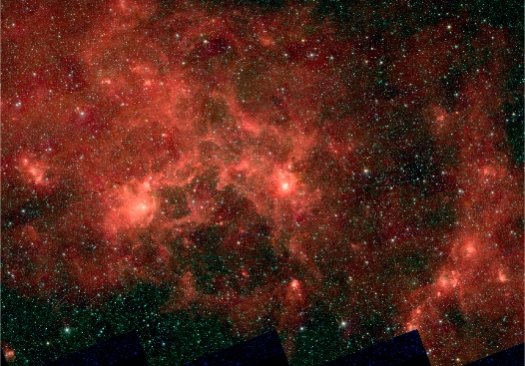
Dragonfish Star Cluster


The Dragonfish star cluster is a group of very massive stars that are embedded in a thin bubble of gas from which they formed. This cluster was recently discovered using the Spitzer Space Telescope, and further studied using the New Technology Telescope in Chile. It's name comes from the fact that the shell of gas (bottom middle) resembles the snarling mouth of a dragonfish. This cluster is made up of many massive stars, some of which may even be 100x the size of our sun! The region around the fishes eye (bright star in the middle) contains more gas and could still be forming stars. Stars this massive don't live very long, so it's likely that star formation in this region won't last very long, as a supernova explosion could blow away most of the material in the next few million years!

Image Credit: NASA/JPL-Caltech/GLIMPSE Team/Mubdi Rahman

Wednesday, January 18, 2012

Voyager Golden Records


Voyager Golden Record (left) and the case it's contained in (right)

In 1977, NASA launched a pair of telescopes called the Voyager Space Telescopes. They were designed to travel to the edges of our solar system and beyond, and send back as much information as possible along the way. Since astronomers knew that these telescopes would be leaving the solar system, they wanted to have something on board signifying the telescopes origins, just in case they were picked up by an alien species some day! So onboard these telescopes are two gold plated records called the Voyager Golden Records. The records contain greetings from Earth in many languages, images of various places, and different iconic sounds. Directions on how to build and use a record player are etched on the case that holds to records. The star like symbol shows some of the nearest and brightest stars to Earth. This was placed there to help any alien species pinpoint Earth's location in space. The Voyager Spacecrafts are just now leaving the solar system and have a long way to go before they reach another planetary system.  If you'd like to see some of their content, check out this website: http://spaceplace.nasa.gov/voyager-to-stars/

Monday, January 16, 2012

Itty Bitty Planetary System

Astronomers are working very hard to confirm the existence of potential exoplanets identified by the Kepler space telescope. One such confirmation was made recently, and it's the "smallest" one yet!

 
KOI-961 is a red dwarf star. This means that it still has fusion in its core, but it's much smaller than the sun. In fact, it's only 13% the mass of the sun, and is slightly larger than Jupiter in size! The image above shows KOI-961 and its three planets (to scale) next to Jupiter and four of its moons for a comparison of size. KOI-961 was not originally identified by Kepler as having an exoplanetary system. Astronomers from CalTech looked at the public data released by Kepler, and saw something suspicious in the light curve. They observed this star using both the Palomar Observatory and Keck Observatory, and their results confirmed the existence of a 3 planet system! The planets masses are unknown, but their sizes are ~0.57, 0.73 and 0.78 Earth radii. This suggests that they are rocky planets similar in size to Mars. Planets 1 and 2 are too close to the star to harvest life, but planet 3 is just on the inner edge of the habitable zone! Much more work is needed before we can truly speculate the existence of life on this planet, but the more discoveries we make, the better chance we have of finding a planet just like Earth!

Image Credit: CalTech

Friday, January 6, 2012

GalaxyZoo

If you're following ADYK, you've just learned about spiral and elliptical galaxies, and the Hubble classification scheme for galaxies. Astronomers have so many pictures of galaxies from various telescopes, and need help classifying all of them. Don't worry, there's no need to memorize the Hubble tuning fork or even know anything about galaxies! If you can look at pictures and answer some simple questions then you're good to go!


GalaxyZoo.org is part of NASA's zooniverse project. Zooniverse is a website where the general public can help astronomers study real astronomical data from telescopes. Basically you chose from a variety of tasks, such as classifying galaxies, measuring moon craters, looking for supernova, searching for exoplanets, etc., go through a short training session, and now you are the astronomer! The general public has helped astronomers make many new discoveries, just by spending a little time on zooniverse.  Check out GalaxyZoo today, maybe you will be the next one to make a big discovery!


Tuesday, January 3, 2012

Hubble Classification of Galaxies


The Hubble tuning fork diagram was developed by Edwin Hubble as a way of classifying galaxies based on their shape. Basically, astronomers look through a telescope at a galaxy, and classify it as an elliptical, spiral, or barred spiral. These classifications were discussed in the last ADYK. If the galaxy looks like a fuzzy bright blob, it's classified as an elliptical (E), and a number is assigned based on how round it looks (1=circle, 9=cigar shaped). If a galaxy has deifned circular rings, but not exactly spiral arms, then it's an "S0".  If the galaxy appears to have spiral arms, it's either a regular spiral galaxy (S), or a spiral with a bar like structure through the center (SB). They are also assigned a letter based on how tightly wound the spiral is. "Sa" means tightly wound arms, while "Sc" is very loosely wound arms. These classifications are handy for astronomers, as they can relate the properties of galaxies to their classification. Hubble originally thought that this diagram represented a time sequence, i.e. all galaxies started as round ellipticals (E0), and evolved over time into spirals (SBc or Sc). Astronomers are now able to measure the ages of many galaxies, and we've found some young ellipticals and old spirals, so the tuning fork diagram does not represent a galaxy evolution sequence. One thing to remember is that this classification is based on actual galaxy shape, not observed. For example, from Earth's perspective, you might view a spiral galaxy edge on, but think it's an E7 elliptical because it appears that way. Because of this, it's not easy to classify these galaxies accurately. You can actually help astronomers do this! Check out the next ADYK!

Thursday, December 29, 2011

Spiral and Elliptical Galaxies

Spiral Galaxy M81
Elliptical Galaxy M87

Galaxies come in two different types: Spirals and Ellipticals. When most people think of a galaxy, they think of the classic spiral galaxy with a twisted arm shape (like M81 pictured above). These bright spiral arms contain most of the stars in the galaxies, which is why they are so bright. The number of spiral arms, how compact they are, and the direction they face varies between galaxies. Most spiral galaxies have a central black hole where all the spiral arms meet. Elliptical galaxies (like M87 pictured above) don't really look like a galaxy at all. They are essentially a huge collection of stars, often in an oval shape, and look like a bright fuzzy cloud, or out of focus star. These galaxies have little structure, other than the density of stars increases towards the center, where a black hole often lives. The next ADYK will discuss Edwin Hubble's galaxy classification scheme, a way of categorizing these types of galaxies based on there shape and structure.

Tuesday, December 27, 2011

The Christmas Tree Cluster

 Visible image of the Christmas Tree Cluster

I hope everyone is enjoying the holiday season! To keep with the spirit, today I present the Christmas Tree Cluster! The Christmas Tree cluster is another name for the young star forming region NGC 2264. It's main feature, the cone nebula, has a tree like shape with a bright star on top, mimicking a Christmas tree.  The triangle shaped object is a cloud of gas and dust in which stars are currently forming. The bright star above it has recently formed and has just begun to burn hydrogen in its core. This star appears so bright because it is a B-type star (very bright and hot) which is 10 times the size of our sun! Merry Christmas!

Image Credit: ESO