Monday, August 22, 2011

Distance To The Stars


The stars are really far away, but how exactly do astronomers measure their distance? There are many different ways to measure the distance to an astronomical object, but for "nearby" stars, the easiest method is to use parallax. A stars parallax is a measurement of it's apparent position on the sky, related to very distant background stars, at two different positions in the Earth's orbit around the sun.

 
In the image above we have the Earth orbiting counterclockwise around the sun, a nearby star which we want to measure the distance to, and distant stars which appear stationary during the Earth's movement around the sun. When the Earth is to the left of the sun, the nearby star appears to be amongst distant stars on the right hand side. Six months later, the Earth is to the right of the sun, and the star appears amongst distant stars on the left. Half the apparent angular distance on the sky that the nearby star appeared to move is called parallax and is measured in arcseconds. Arcseconds are an angular measurement on the sky, defined such that a star that in one parsec (~19 trillion miles) away from Earth will have a parallax of 1 arcsecond. Using basic geometry, we find that the distance to any nearby star (in parsecs) is equivalent to 1/parallax (in arcseconds), or d=1/p. Just by using simple math that you probably learned in high school, you can calculate the distance to the stars. No calculus or crazy physics required! Now finding the distance to much more distant objects is a bit trickier, and will be the topic of future posts.

Image Credit: astroprofspage.com

Wednesday, August 17, 2011

We Really Are Stardust

Where did human life come from? That's the ultimate question. Science offers two solutions to this question. One is that life was placed here either by an intelligent being, or by chance via a meteorite back when the Earth was very young. The second option is that space is filled with the building blocks of life, and the gas and dust that the Earth formed from happened to contain these materials. Until now there was really no strong proof either way, but just recently astronomers made a huge discovery. Astrobiologists were studying the composition of a meteorite they found in the arctic and discovered guanine and adenine, two of the four building blocks of DNA! These proteins have never been found in outer space before, and astronomers believed conditions to be too harsh for these proteins to survive. Finding guanine and adenine in this meteorite suggests that these and other building block of DNA are created during supernova explosions and exists all throughout outer space. It's likely that these materials existed in the circumstellar disk around the sun back when it was very young, and therefore ended up here on Earth.  This also promotes the idea that other intelligent life may be out there since the building blocks for life seem to be free floating through space. There are of course religious based views on the formation of life, which I respect very much, but from a purely scientific standpoint, it appears that we really are a product of the stars.

Image Credit: NASA
Go to NASA.gov to read the article pertaining to this discovery.

Sunday, August 14, 2011

Star Trails


 Images like the one above are often taken by artistic astronomers and are called star trails. Stars, just like the sun and moon, rise and set every night due to the rotation of the Earth. These pictures show the path in which stars move across the sky over a single night.  To image star trails, you either need to leave the shutter open on your camera all night and take one long picture, or take hundreds of images  all night long and stack them together. Notice in the image above that many stars appear to rise above the horizon on the east and set on the west, but some move in a full circle and never rise or set. These stars are called circumpolar stars. Imagine you are standing at the tip of the North pole and looking up at the stars. All of the stars would appear circumpolar because you are standing on the tip of Earth's spin axis (also called the north celestial pole). Now if you move down to North America you'll be on the side of Earth's spin axis, and only some stars (those in the direction of the north celestial pole) will appear circumpolar. Similarly, if you are at the equator (middle of earth) there will be no circumpolar stars, because the north and south celestial poles sit exactly on the horizon. Based on images of these star trails you could measure the exact latitude of your location on Earth.

Thursday, August 11, 2011

The Fate of the Universe


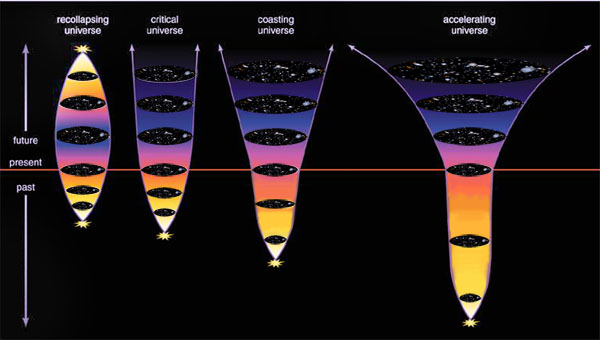
 Astronomers can use telescopes to look deep into space, where essentially we are looking back in time, and try to understand how the universe began. We know from observations that the universe is about 14.5 billion years old, and that it's currently expanding due to some Big Bang or moment of Inflation sometime in the past. Based on the current structure of our universe, and the theories behind how it began, astronomers are trying to predict the fate of our universe. What will eventually happen to the universe billions of years from now?  Below are four current theories.

 
  1. Infinite Expansion: The universe will expand forever. We will survive, but eventually loose contact with places that are too far away and ultimately be isolated in darkness.
  2. The Big Rip: The expansion of the universe will continue to increase until it expands so fast that spacetime itself is ripped to shreds. The fate of humanity is unknown.
  3. The Big Chill: The universe will expand and continue to cool until it reaches absolute zero. At this temperature, all movement will cease and black holes will evaporate into the vacuum of space. Essentially we will freeze to death.
  4. The Big Crunch: gravitational pull from black holes  will cause the expansion of the universe to stop, and the universe will collapse back onto itself. We will not survive, but a new universe may be created in a second big bang after the crunch. 

As time goes by we hope to learn more about the structure of our universe and be able to accurately predict which one of the above (or a completely different scenario) will be true. Sadly, none of these scenarios are "happy endings".  I guess our best hope lies in the bubble universe theory. This says that other universes have budded off of ours and are completely separate and now unbound to ours.  If we are in trouble in the future, maybe we will have the technology to travel to a more stable bubble universe and continue to live there!

Image credit: LSST

Monday, August 8, 2011

Flowing Water On Mars!


The above image was taken back in May by the Mars Reconnaissance Orbiter, a satellite orbiting Mars that takes photos of the Martian surface. First released last Friday, the image depicts dark brown streaks  on the edge of a crater. These streaks appear during the Martian summer, then fade away during the winter months, and reappear again the next summer. It's believed that these streaks are actually flowing  liquid salt water on Mars! That's right, I said flowing liquid water! Over the past decade or so, astronomers have found much evidence that water flowed on Mars sometime in the past, but they believed that conditions on Mars today are too harsh to support liquid water. I guess they were wrong!

The main thing preventing liquid water from flowing on other planets is temperature. Planets closer to the sun than Earth are too hot; any water would evaporate. Planets farther away from the sun than earth are too cold; any water would freeze. Temperatures on Mars range from 68 F during the summer, to -124 F in the winter, with an average of -81F. So in the summer months Mars can get warm enough to have flowing liquid water! One thing that also helps is the fact that the Martian surface is very salty. This salt gets dissolved in any surface water, lowering the freezing point of water and preventing it from turning to ice. (This is why we throw salt on the roads in the winter, it lowers the waters freezing point preventing ice from forming.) Any water on Mars will be very salty, allowing it to be in liquid form at fairly cold temperatures. Water that has dissolved as much salt as it can possibly handle has a freezing point of -4 F.

This discovery  of this water on Mars has once again peaked interest in astronomers minds about searching for life on Mars. Maybe there are some microbes or bacteria that live in the water during the summer months? We will have to wait for the next round of Mars rovers to find out!

Image Credit:HiRISE, MRO, LPL (U. Arizona), NASA

Wednesday, August 3, 2011

The Many Types of Disks

If you've ever read an article about young stars, or seen an image of a star forming region, you've probably come across talk of disks around stars. Stars form from giant disks of material slowly falling, or accreting, onto them, so we expect to see disks around young stars. There are many different types of disks, and what you call the disk depends on the age of the star, the disk structure, and other properties of the system. Below are some definitions of different types of disks so you will understand what astronomers are referring to.

Circumstellar Disk: A generic term used to describe a disk of gas, dust, and rocky material around a young star. Most of the following disks are specific types of circumstellar disks.

Accretion Disk: A disk of gaseous material that spinning around and falling onto the young star. Often the inner portion of a circumstellar disk. Accretion disks can exist around other objects as well, such as black holes.

Protoplanetary Disk: A disk around a star that has aged ~3 million years or more containing mostly dust particles and rocks. This is the type of disks that planets form from.

Transition Disk: A slang term for a circumstellar disk around a young star that has a clear hole between the star and the edge of the disk. This occurs, for example, when a large planet forms and clears out a small portion of the disk.

Circumbinary Disk: A disk of material around a binary star system (two stars gravitationally bound to each other.) The disk surrounds both stars at once as if they were one object.

Debris Disk: A disk of material around an older star of any type. If a star begins burning Hydrogen in its core and still has a disk around it, it's called a debris disk. Also, a disk around a neutron star or a white dwarf would be referred to as a debris disk. These may occur from interactions with nearby stars, catastrophic collisions between planets in a system, or after the star dies and explodes.

Infrared image of a circumbinary disk around GG-Tau, taken with Gemini in Hawaii. The two stars are where the star symbols are (their light is blocked out on purpose) and the blue/white is the disk of material.

Image Credit: Gemini Observatory/AURA

Monday, August 1, 2011

HII Regions

Have you ever seen an image of a colored cloud in night sky with the caption HII (read "H-two") region under it? Or heard that the Orion Nebula, pictured below,is  an HII region? HII regions make for nice telescope images, but do you know what they are?

 
Clouds of hydrogen gas in the form of molecular hydrogen (H2)or atomic hydrogen (HI) are where star formation often takes place. These gas clouds collapse in various places, triggering the formation of stars. Groups of young, hot stars emit lots of ultraviolet light which is very energetic. This light is absorbed by some of the atomic hydrogen, causing the hydrogen to lose a electron or become ionized (now called HII). The more stars that form, the more hydrogen they ionize, and thus the larger the HII region. These regions exist most often within the spiral arms of galaxies, where we know star formation is occurring. HII regions exist until some of the young stars within them age and die in a supernova explosion. This explosion causes any HII in the area to be blown away, leaving behind an open cluster of stars.

Image Credit: NASA/ESA