Friday, August 26, 2011

A Planet Made of Diamond!


 Artist's impression of the diamond planet

You read that right! Astronomers believe that they have discovered an exoplanet made of diamond! How can this happen? Well here's the scenario. There was once two stars orbiting each other in a binary system in our galaxy. One star was  bigger than other, and began stealing material from the other smaller star. Over time, the large star stripped so much material off the small star that it couldn't withstand the external pressure and exploded as a supernova! This huge explosion cleared away any gas and star material in the area, leaving behind only the core of the large star (now called a neutron star) and a the core of the small star. Because this is a binary system, the leftover cores began to orbit each other extremely quickly. The angular momentum in the system (speed of rotation, essentially) caused the neutron star to spin on its axis in a fraction of a second (once every 0.0057 seconds to be exact)! We call these stars pulsars, as they emit light from their poles which appears as mili-second pulses in radio telescopes. The small star's core now orbits the pulsar so closely that it only takes two hours for the planet to go around the star! Based on orbital speed and distance to the host star, astronomers speculate that it is less than half the size of Jupiter, but weighs about 1.2 times as much! This high density suggests that the star is made of carbon, and its close proximity to the host star would make it crystallized. And you know what crystallized carbon is… Diamond! A planet 5 times the size of Earth made diamond. I Think I agree with other astronomers who suggest that we somehow find a way to travel to this planet and bring some diamond back! (Though it's quite implausible.) Wouldn't it be awesome to have an exoplanet-diamond ring ? And I thought a meteorite necklace was cool!

Wednesday, August 24, 2011

Our Solar System


After some recent teaching experiences and discussions, I've come to realize that many adults have forgotten the basics about our solar system. So today ADYK presents a Solar System "refresher" to help you recall those astronomy facts you learned back in elementary school.


Above is a collection of real telescope images of the planets in our solar system (NOT to scale!). This is what the planets look like when you use very high power telescopes or planet orbiting satellites to observe them.

Our solar system contains 8 planets (Pluto doesn't count anymore),  one star (the Sun) and two large asteroid belts. Mercury, Venus, Earth and Mars and the four closest planets to the sun and are often called the terrestrial or rocky planets. They are basically giant chunks of rock in a roughly spherical shape. Mercury is made mostly of metals and is heavily cratered like the moon. Venus has a thick carbon dioxide atmosphere, and is essentially the poster child for what would happen if global warming got out of hand on earth. Earth is our home and is made of 70% salt water and has a rich Nitrogen atmosphere. Mars is the red planet where all the aliens live, supposedly. (*wink wink*). Beyond Mars sits the first asteroid belt, filled with oddly shaped rocks the size of people to the size of cities. Jupiter, Saturn, Uranus and Neptune sit beyond the asteroid belt and are often called the gaseous or Jovian planets. Jupiter is the largest planet, about 10x the size of Earth, and has that big red spot. Saturn is the one with the prominent ring structure, though all Jovian planets have a slight ring structure around them. Uranus and Neptune are the blue planets, and are about 4x the size of Earth. Uranus is turned on it's side, meaning that its spin axis is tilted 90 degrees from being straight "up and down". Past the Jovian planets is the Kuiper belt, a giant ring of asteroids which defines the edge of the solar system. Pluto, it's moons, and over 70,000 similar objects orbit in this ring. Most everything there is small, cold, and icy.

There you go, elementary school astronomy class in one paragraph!

Monday, August 22, 2011

Distance To The Stars


The stars are really far away, but how exactly do astronomers measure their distance? There are many different ways to measure the distance to an astronomical object, but for "nearby" stars, the easiest method is to use parallax. A stars parallax is a measurement of it's apparent position on the sky, related to very distant background stars, at two different positions in the Earth's orbit around the sun.

 
In the image above we have the Earth orbiting counterclockwise around the sun, a nearby star which we want to measure the distance to, and distant stars which appear stationary during the Earth's movement around the sun. When the Earth is to the left of the sun, the nearby star appears to be amongst distant stars on the right hand side. Six months later, the Earth is to the right of the sun, and the star appears amongst distant stars on the left. Half the apparent angular distance on the sky that the nearby star appeared to move is called parallax and is measured in arcseconds. Arcseconds are an angular measurement on the sky, defined such that a star that in one parsec (~19 trillion miles) away from Earth will have a parallax of 1 arcsecond. Using basic geometry, we find that the distance to any nearby star (in parsecs) is equivalent to 1/parallax (in arcseconds), or d=1/p. Just by using simple math that you probably learned in high school, you can calculate the distance to the stars. No calculus or crazy physics required! Now finding the distance to much more distant objects is a bit trickier, and will be the topic of future posts.

Image Credit: astroprofspage.com

Wednesday, August 17, 2011

We Really Are Stardust

Where did human life come from? That's the ultimate question. Science offers two solutions to this question. One is that life was placed here either by an intelligent being, or by chance via a meteorite back when the Earth was very young. The second option is that space is filled with the building blocks of life, and the gas and dust that the Earth formed from happened to contain these materials. Until now there was really no strong proof either way, but just recently astronomers made a huge discovery. Astrobiologists were studying the composition of a meteorite they found in the arctic and discovered guanine and adenine, two of the four building blocks of DNA! These proteins have never been found in outer space before, and astronomers believed conditions to be too harsh for these proteins to survive. Finding guanine and adenine in this meteorite suggests that these and other building block of DNA are created during supernova explosions and exists all throughout outer space. It's likely that these materials existed in the circumstellar disk around the sun back when it was very young, and therefore ended up here on Earth.  This also promotes the idea that other intelligent life may be out there since the building blocks for life seem to be free floating through space. There are of course religious based views on the formation of life, which I respect very much, but from a purely scientific standpoint, it appears that we really are a product of the stars.

Image Credit: NASA
Go to NASA.gov to read the article pertaining to this discovery.

Sunday, August 14, 2011

Star Trails


 Images like the one above are often taken by artistic astronomers and are called star trails. Stars, just like the sun and moon, rise and set every night due to the rotation of the Earth. These pictures show the path in which stars move across the sky over a single night.  To image star trails, you either need to leave the shutter open on your camera all night and take one long picture, or take hundreds of images  all night long and stack them together. Notice in the image above that many stars appear to rise above the horizon on the east and set on the west, but some move in a full circle and never rise or set. These stars are called circumpolar stars. Imagine you are standing at the tip of the North pole and looking up at the stars. All of the stars would appear circumpolar because you are standing on the tip of Earth's spin axis (also called the north celestial pole). Now if you move down to North America you'll be on the side of Earth's spin axis, and only some stars (those in the direction of the north celestial pole) will appear circumpolar. Similarly, if you are at the equator (middle of earth) there will be no circumpolar stars, because the north and south celestial poles sit exactly on the horizon. Based on images of these star trails you could measure the exact latitude of your location on Earth.

Thursday, August 11, 2011

The Fate of the Universe


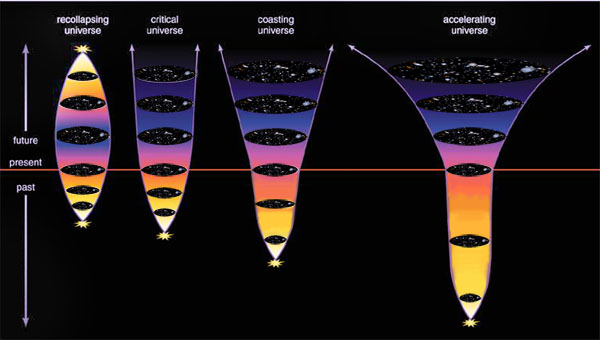
 Astronomers can use telescopes to look deep into space, where essentially we are looking back in time, and try to understand how the universe began. We know from observations that the universe is about 14.5 billion years old, and that it's currently expanding due to some Big Bang or moment of Inflation sometime in the past. Based on the current structure of our universe, and the theories behind how it began, astronomers are trying to predict the fate of our universe. What will eventually happen to the universe billions of years from now?  Below are four current theories.

 
  1. Infinite Expansion: The universe will expand forever. We will survive, but eventually loose contact with places that are too far away and ultimately be isolated in darkness.
  2. The Big Rip: The expansion of the universe will continue to increase until it expands so fast that spacetime itself is ripped to shreds. The fate of humanity is unknown.
  3. The Big Chill: The universe will expand and continue to cool until it reaches absolute zero. At this temperature, all movement will cease and black holes will evaporate into the vacuum of space. Essentially we will freeze to death.
  4. The Big Crunch: gravitational pull from black holes  will cause the expansion of the universe to stop, and the universe will collapse back onto itself. We will not survive, but a new universe may be created in a second big bang after the crunch. 

As time goes by we hope to learn more about the structure of our universe and be able to accurately predict which one of the above (or a completely different scenario) will be true. Sadly, none of these scenarios are "happy endings".  I guess our best hope lies in the bubble universe theory. This says that other universes have budded off of ours and are completely separate and now unbound to ours.  If we are in trouble in the future, maybe we will have the technology to travel to a more stable bubble universe and continue to live there!

Image credit: LSST

Monday, August 8, 2011

Flowing Water On Mars!


The above image was taken back in May by the Mars Reconnaissance Orbiter, a satellite orbiting Mars that takes photos of the Martian surface. First released last Friday, the image depicts dark brown streaks  on the edge of a crater. These streaks appear during the Martian summer, then fade away during the winter months, and reappear again the next summer. It's believed that these streaks are actually flowing  liquid salt water on Mars! That's right, I said flowing liquid water! Over the past decade or so, astronomers have found much evidence that water flowed on Mars sometime in the past, but they believed that conditions on Mars today are too harsh to support liquid water. I guess they were wrong!

The main thing preventing liquid water from flowing on other planets is temperature. Planets closer to the sun than Earth are too hot; any water would evaporate. Planets farther away from the sun than earth are too cold; any water would freeze. Temperatures on Mars range from 68 F during the summer, to -124 F in the winter, with an average of -81F. So in the summer months Mars can get warm enough to have flowing liquid water! One thing that also helps is the fact that the Martian surface is very salty. This salt gets dissolved in any surface water, lowering the freezing point of water and preventing it from turning to ice. (This is why we throw salt on the roads in the winter, it lowers the waters freezing point preventing ice from forming.) Any water on Mars will be very salty, allowing it to be in liquid form at fairly cold temperatures. Water that has dissolved as much salt as it can possibly handle has a freezing point of -4 F.

This discovery  of this water on Mars has once again peaked interest in astronomers minds about searching for life on Mars. Maybe there are some microbes or bacteria that live in the water during the summer months? We will have to wait for the next round of Mars rovers to find out!

Image Credit:HiRISE, MRO, LPL (U. Arizona), NASA